
Fabric Blinds Curtain Rods Window Treatments Trims & Tassels Wallpaper
1-800-590-5844
Measure Your Windows for Blinds and Shades

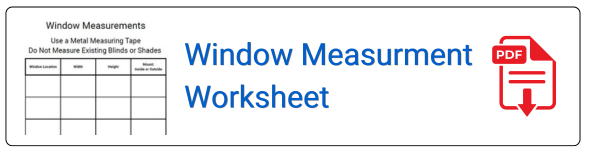
Use a metal measuring tape, not a short ruler or stretchy cloth tape measure. Measure all windows, even if they appear to be the same size. The differences may surprise you. Record width first, then height (also referred to as length) to the nearest 1/8".
NOTE: All measurements should come from measuring the window. If you measure your existing blinds, the measurements will be incorrect. Do not take your own deductions. The factory will take necessary deductions and allowances.
Inside Mount
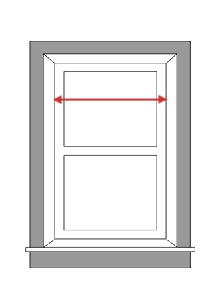 Inside mount blinds and shades are installed inside the window casing. The window covering will hang inside the window frame. Minimum depth requirements vary by product and headrail type, or by tube size for Solar Shades.
The window covering will hang inside the window frame. We recommend an inside
mount
whenever possible for a neater look. When you order, enter the exact dimensions
of
your window without making any allowances. The factory will take all necessary
deductions for inside mounts.
Width: Measure the EXACT distance across the
window from the inside edge of the frame to the opposite
inside edge in three places. Use the narrowest
dimension.
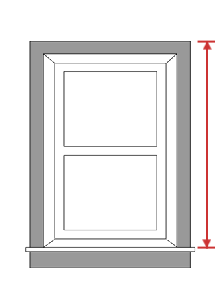
Height: Measure the EXACT distance from the top inside
edge of the frame to the bottom inside edge of the frame
in three places. Use the longest dimension for
horizontal coverings, and the shortest for vertical
coverings.
Window Depth: The amount of space from the back of the window or obstruction to the windows outer edge.
Outside Mount
 The window covering will hang outside the actual window frame, over lapping
the window frame for maximum privacy and light blockage. Blinds require a flat, continuous mounting surface. If your window has a casement, the headrail may be mounted directly to the front face of the casement, which provides a level plane for the brackets. The side walls around the casement cannot be used, because they sit recessed behind the casement and do not align with the headrail.
If you need the blind to extend wider than the casement, the headrail must be mounted above the casement, where the wall surface is flat, unobstructed, and in the same plane across the full width of the blind.
The window covering will hang outside the actual window frame, over lapping
the window frame for maximum privacy and light blockage. Blinds require a flat, continuous mounting surface. If your window has a casement, the headrail may be mounted directly to the front face of the casement, which provides a level plane for the brackets. The side walls around the casement cannot be used, because they sit recessed behind the casement and do not align with the headrail.
If you need the blind to extend wider than the casement, the headrail must be mounted above the casement, where the wall surface is flat, unobstructed, and in the same plane across the full width of the blind.
Width: Measure the desired width. To minimize light leakage the shade should
overlap the window opening by 1 1/2" to 2" on each side and at the bottom.
Height: Measure the distance from the top outside edge of the window frame
the
bottom outside edge of the frame. If there is not a window frame add at least
2"
inches on the top and the bottom to minimize light leakage. The headrail on
a wood or faux wood 2" blind is about 2 1/2" high.
Leave room for the mounting brackets, which are about 2-1/2" tall
For Solar Shades make sure the measurement overlaps the window opening by at least 3" on each side (6" total overlap) to ensure light control and privacy.
For Vertical Blinds see our Vertical instructions
Flush Mount
1.50" for 1" and 1/2" Mini Blinds, 3/8" Honeycomb Shades
and Pleated Shades
2.25" for 1" Wood Blinds and 3/4" Honeycomb Shades
3.00" for 2" Aluminum Blinds and 2" Wood blinds
4.75" for Vertical Blinds